
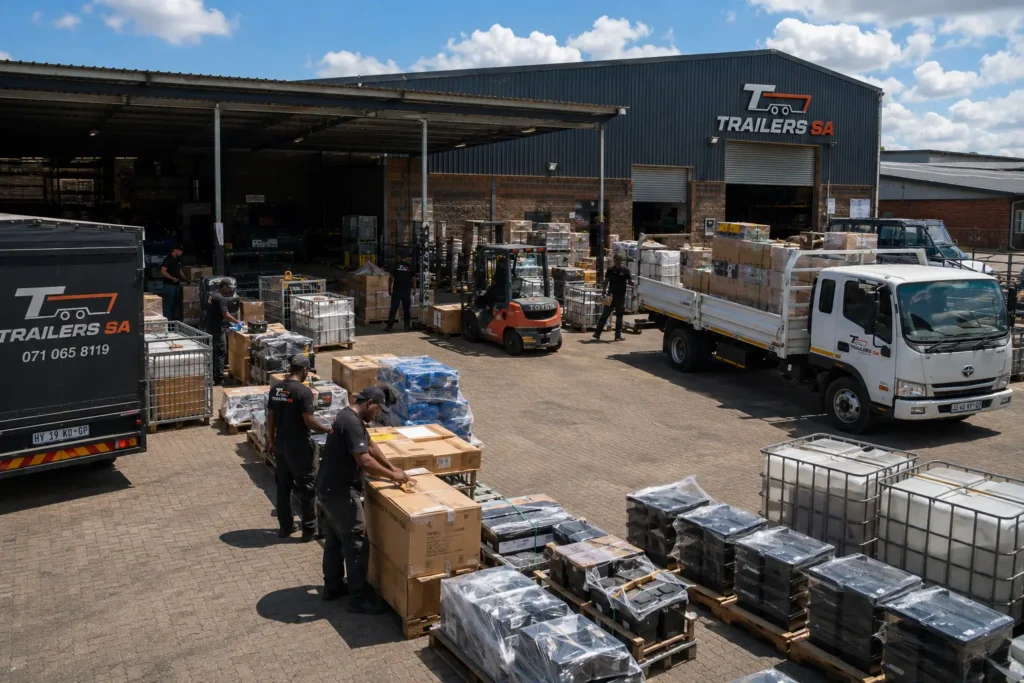
Parts on the shelf, a workshop that repairs any make, and honest servicing intervals for a trailer that spends its life on gravel. The aftersales side is run from the same works in Hartswater that builds the trailers.
Spares we hold
These are the parts that actually fail, in the order they usually fail:
- Wheel bearings and seals. The single most common trailer failure, and the cheapest to prevent.
- Lighting. Four-in-one combination rear lamps, bulbs, seven-pin plugs and sockets, and the wiring loom.
- Couplers. Non-braked cast couplers from 750 kg, braked overrun couplers at 1.5, 2, 2.5 and 3 ton, and galvanised cast-iron units with hydraulic dampers.
- Jockey wheels. 48 mm single and 60 mm double, plus clamps.
- Axles and springs. Round and square axles in the rated sizes, and leaf packs from five to ten blades.
- Wheels and tyres. 13, 14 and 15 inch, plus spare wheel brackets.
- Safety equipment. Chevron boards, 50 mm reflective tape, red and white mudguard reflectors.
- Covers and tie-downs. PVC covers, mesh panels, ratchet straps.
- Bowser fittings. Filler caps, breathers, outlet fittings and tank hardware.
Parts are couriered anywhere in the country. Send a photograph of the part you are replacing rather than trying to describe it, and we will match it.
Repairs on any make
We repair trailers we did not build. The workshop handles bearing replacement and hub work, brake overhaul and adjustment, coupler replacement, full rewires and lighting faults, chassis straightening and weld repair after impact, drop side and tailgate repair, floor replacement, and tank repair including leak testing.
If a trailer has been in an accident, send photographs before you tow it anywhere. A bent A-frame or a cracked chassis is not always safe to move, and it is a different repair depending on whether the damage is in the drawbar, the main rails or the crossmembers.
Roadworthy preparation
A trailer needs to pass a roadworthy inspection to be registered and licensed, and again on change of ownership. The items an examiner looks at are predictable, which means they are preventable.
- Lighting complete and working, including the number plate light
- Reflectors correct: red at the rear, white at the front, amber at the sides where required
- Chevron board fitted and in condition
- Tyres with legal tread, no cuts or sidewall damage, correctly matched
- Coupler locking properly, safety chain present
- Brakes operating on a braked trailer, with the breakaway cable intact
- No cracked welds or corroded structure in the chassis
- Number plate fitted and legible
Bring the trailer in and we will work through that list and fix what fails before you waste a slot at a testing station.
Servicing intervals
These are the intervals we recommend for a trailer used in South African conditions. A trailer that lives on tar can stretch them. A trailer that lives on farm roads should not.
Before every trip
Tyre pressures including the spare. Lights, with someone standing behind the trailer. Coupler engaged and locked. Load secured. Jockey wheel raised and clamped.
Every three months, or 5,000 km
Wheel nut torque. Tyre wear pattern, which tells you about axle alignment. Brake adjustment on a braked unit. Lighting connections and plug pins. A visual check along every weld line.
Every twelve months, or 10,000 km
Strip, inspect and repack the wheel bearings. Replace seals. Full brake inspection including linings and cables. Suspension bushes and shackle pins. Coupler wear. Touch up any paint damage before it becomes rust.
Bearings are worth repeating. A dry bearing gives you almost no warning, seizes at speed, and can take the axle stub with it. Repacking bearings once a year costs less than a tow truck.
Fitting parts yourself
Lighting, jockey wheels, spare wheel brackets, covers and straps are straightforward to fit with basic tools, and we will talk you through anything that is not obvious. Bearings, brakes, axles and couplers are a different matter. Those are load-bearing or safety-critical, they need the right torque and the right grease, and a bearing packed by hand without cleaning the hub first will fail sooner than the one you replaced. If you are not set up for it, bring it in.
Bowser servicing
A fuel bowser has a service list of its own on top of the running gear. Check the filler cap seal and the tank breather, because a blocked breather will deform a tank under suction. Drain water from the bottom of a steel tank before it sits over a wet season. Inspect hose, nozzle and any filter element for perishing and replace on condition rather than on hope. Never weld on or near a tank that has held fuel unless it has been properly purged, and that is a job for the workshop.